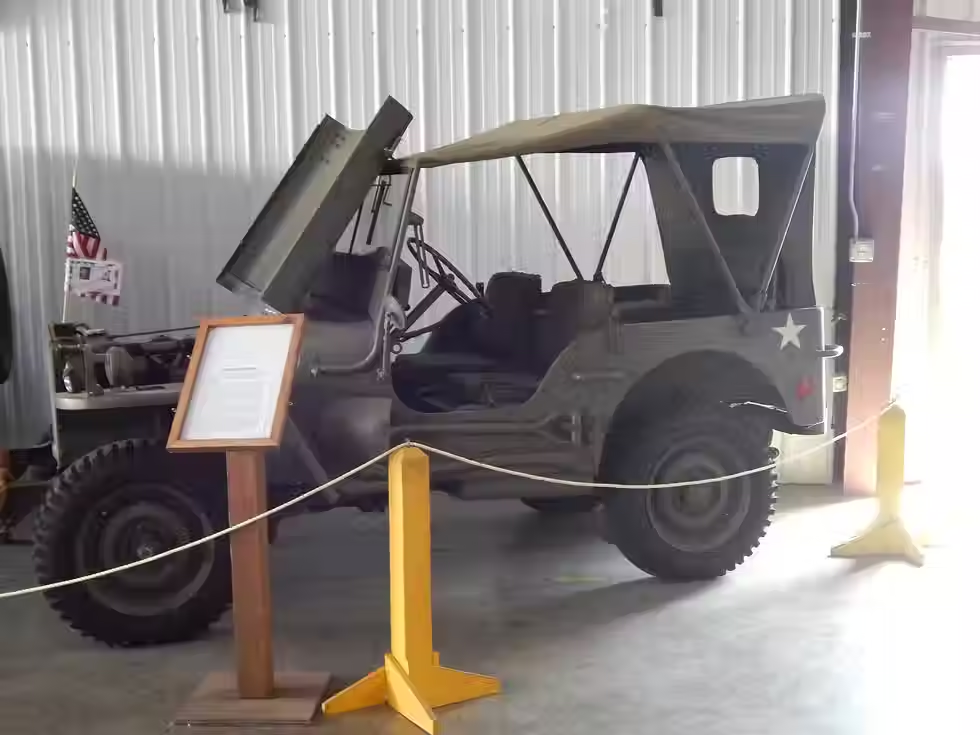
Ford GPW Jeep
One of the most famous military vehicles of World War II, the jeep originated in a prewar US Army requirement for a simple, inexpensive, and robust vehicle for basic utility chores. Its simple design proved to be adaptable to a host of military tasks including use as a scout vehicle, battlefield ambulance, communications vehicle, and staff car.
The Ford GPW at the Arkansas Air & Military Museum was built in the first six months after the attack on Pearl Harbor. If you look at the rear of the truck you will see the Ford name pressed into the rear of the vehicle. This practice was stopped in July, 1942.
The designation “GPW” breaks out as follows: “G” is “Government,” “P” represents “80-inch wheelbase reconnaissance” and “W” for “Willys” as they were the designers of the original blueprints on which the jeeps were based. The Willys MB or Ford GPW army jeep is the one most people think of when talking about military jeeps. It is known by many names, such as the Willys Jeep, the GI Jeep, the World War II jeep, or just plain Army jeep.
This jeep resulted from a 1940 design competition that involved American Bantam, Willys-Overland, and Ford. Willys was chosen for the first mass production contract based on the Willys MA design, but the Willys MB which followed incorporated superior features from the Bantam BRC-40 and the Ford GP in addition the the Willys MA. When the War Department realized that hundreds of thousands of jeeps would be needed for World War II requirements, Ford was given a contract to produce the Willys MB design.
Ford produced jeeps were designated GPW. The Willys MB or Ford GPW jeep of World War II were externally visually the same but with many small differences in production details. It was also common to install parts from Willys into a Ford jeep and vice versa. As WW II went on, field maintenance facilities used whatever parts were at hand without regard to the original manufacturer of the part or the jeep.
There are many other details of the Willys MB or Ford GPW that are different. If you are with the jeep, you can see if it has the Ford script F embossed on the rear panel of the body tub or has the F stamped on most bolt heads. The early production Willys MB jeeps, about 25,800 of them, had a grill made of vertical welded slats (called the "slat grill" type, photo right) and had "Willys" embossed in the back panel among other small differences.
When Ford began producing the nearly identical GPW (with Ford embossed on the back panel) in January of 1942, they used the now-standard, less expensive stamped steel slotted jeep grill. The Army wanted full parts interchangeability and worked with Ford and Willys to get a single standard design for both jeeps - the Ford idea for the grill was better, so Willys switched to the stamped grill by April 1942. The Army also insisted that both Willys and Ford drop the embossed company name from the jeep exterior.
The main chassis or body component that distinguished a Willys-Overland MB from the Ford-built GPW is the tubular front frame cross-member on the MB as opposed to the inverted U-shaped cross-member on the GPW with a flat top. During the course of the war, Ford built 277,896 GPW jeeps. Production contracts were terminated in the summer of 1945 as World War II ended. The last Ford GPW was built on 30 July 1945.